

The goal of this website is to gather information regarding the 1996 Super Famicom game Traverse: Starlight & Prairie. Magazine articles and other promotional materials related to the game are added to and detailed on the BIBLIOGRAPHY page. There are no plans to translate the articles into English, but OCR transcriptions of the Japanese texts will be supplied in due course to compensate for this.
The focus of the research is currently on collecting and scanning articles about the game that appeared in Japanese gaming magazines in the years 1995–1996. Any missing articles published prior to the release of the game are especially sought after so that a better timeline of the game's development may be properly established.
If you happen across any additional articles, ads or any other Traverse: Starlight & Prairie related media not featured on this site yet, please don't hesitate to use the CONTACT page to let us know about it!

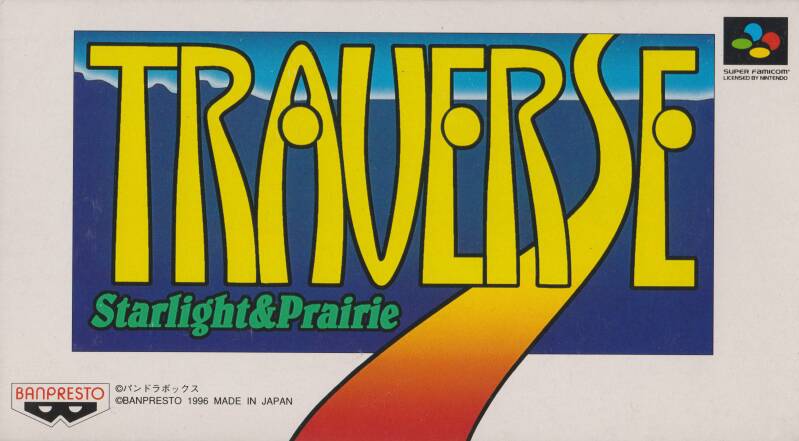
The front cover of the game box (above).
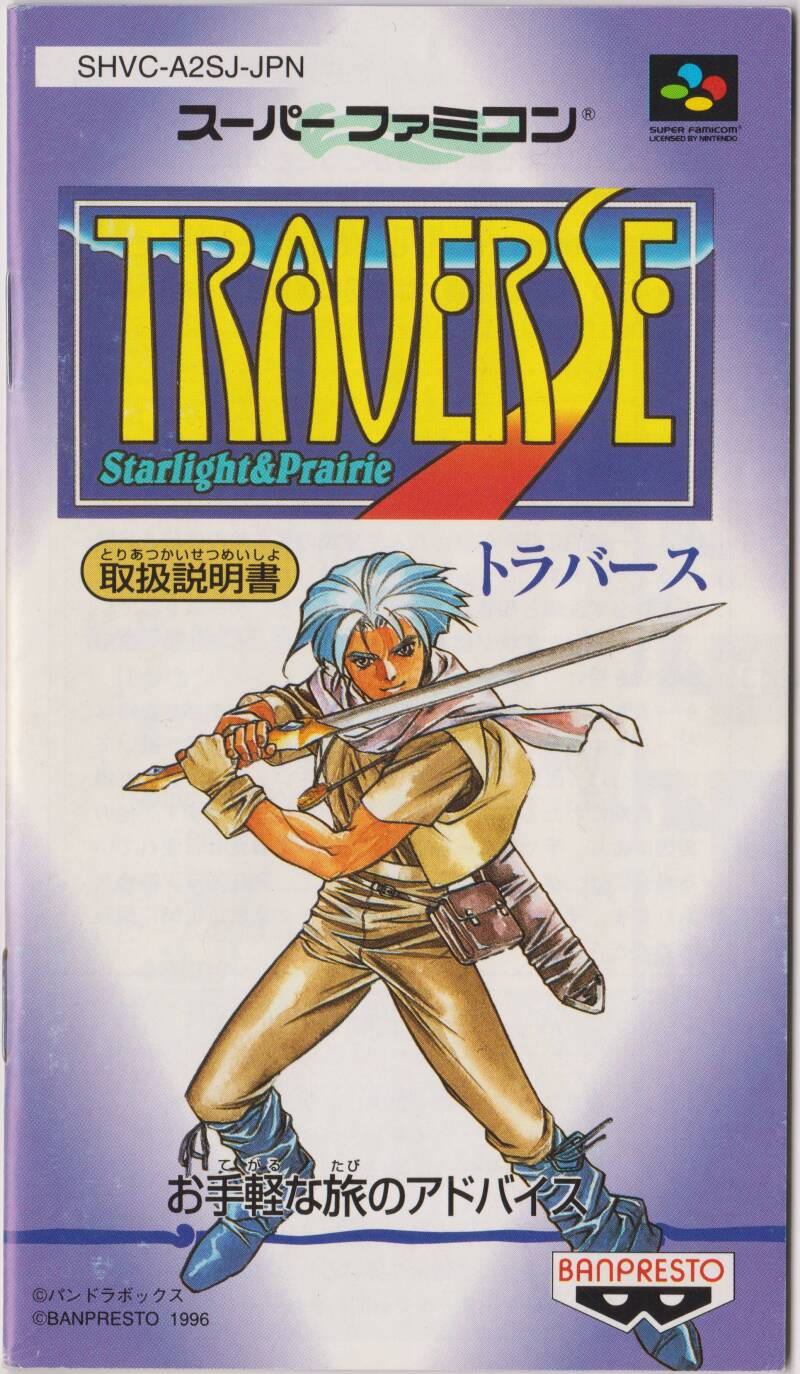
The cover of the manual included with the game box (above), and a short blurb found on the back of the game box (below).
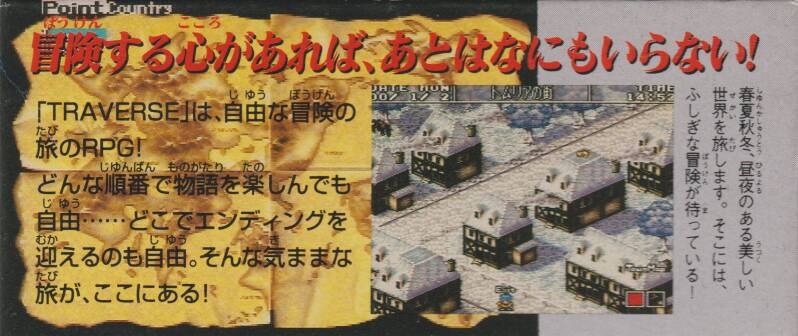
冒険する心があれば、あとはなにもいらない!
「TRAVERSE」は、自由な冒険の旅のRPG!
どんな順番で物語を楽しんでも自由……どこでエンディングを迎えるのも自由。そんな気ままな旅が、ここにある!
➤ 春夏秋冬、昼夜のある美しい世界を旅します。そこには、ふしぎな冒険が待っている!
TRAVERSE Starlight & Prairie (トラバース スターライト&プレーリー) is a Japan-only RPG released on 26 June, 1996 for the Super Famicom system. The game is a sequel to Soul & Sword (ソウル&ソード), a Japan-only RPG released on 30 November, 1993. Both games were developed by Pandora Box, Soul & Sword having been published by Zamuse (a subsidiary of Banpresto) while TRAVERSE was published by Banpresto.
The story of TRAVERSE follows the travels of the 14-year-old boy Gant, who decides to leave his hometown in search of adventures along with his childhood friend Sonia and a ruffian named Balmore. The player is technically free to find and experience the adventures in the game in any order they choose, though many of the adventures require certain conditions and others must be finished in a specific order.
The ending of the game can be instigated by the player at any point by choosing to marry one of the 15 marriage partners available in the game. Some partners require the completion of a specific event or sufficient player stats. There are also several ways to achieve a "bad ending" during the player's adventures, such as when choosing a wrong choice in some conversations, or by losing in battle against common monsters and most bosses. A true ending can be achieved by completing a certain set of conditions, including finishing most of the game's adventures and ultimately choosing Sonia as the marriage partner.
Many of the events and decisions faced by the player are influenced by the robust time and weather system in TRAVERSE, where time of the day, weather and seasons pass and change as the player continues to play and traverse in the game world. If 10 years of in-game time are reached, the player is met with a forced ending to their adventure.
Reception of TRAVERSE in 1996
TRAVERSE received fair to average ratings from the gaming press at the time. In general, the open-ended nature of the game was remarked in a positive light. On the other hand, the game's user interface received criticism, as did the fact of how difficult it was to locate and initiate many of the game's adventures in the first place without a guide. Some reviewers also found the walking speed in dungeons and the pace of battles to feel cumbersome.
Multiple reviews of TRAVERSE appeared in various Japanese gaming magazines starting around early July, 1996. Please see the articles found on the BIBLIOGRAPHY page of this website to view any of the (so far discovered) articles discussing TRAVERSE in the years 1995 to 1996.
State of Western Release or Fan Translation
As of June 2026, neither TRAVERSE or its prequel Soul & Sword has been ported or fan translated into English. Concurrently, the text-heavy, role-playing nature of the game proves a challenging playing experience to anyone without a good grasp of the Japanese language.
Create Your Own Website With Webador